A power electrical transformer changes the voltage of electricity to meet your needs. You find an electrical transformer in many devices and systems. A power electrical transformer helps you use electricity safely and efficiently.
The global power transformer market size reached USD 25.47 billion in 2024.
Experts expect it to grow to USD 27.02 billion in 2025.
You depend on an electrical transformer every day. Each power electrical transformer allows you to power your home and business. An electrical transformer ensures a steady and safe flow of electricity.
Transformers adjust voltage levels to ensure safe and efficient power delivery for homes and businesses.
Choosing the right transformer reduces energy loss and protects your devices from damage.
Transformers play a crucial role in various applications, from residential power to industrial machinery.
The core forms the backbone of every transformer. You find the core at the center, where it guides the magnetic field. The material you choose for the core affects how well the transformer works. Here is a table showing common core materials and their advantages:
| Material | Advantages |
|---|---|
| Cold Rolled Grain Oriented Steel | High efficiency, low losses, best for power transmission. |
| Amorphous Steel | Low no-load losses, saves energy when the transformer is not working at full load. |
| Nanocrystalline Materials | Very high permeability, handles high frequencies, stays stable at high temperatures. |
A good core helps your transformer run efficiently and reduces wasted energy.
Windings are coils of wire wrapped around the core. You find two main windings in every transformer: the primary and the secondary. The design of these windings affects how well your transformer performs.
Thick wires and smart winding layouts lower copper loss.
Wires with low resistance and good heat flow keep the transformer cool.
Special winding techniques, like using several wires together, help current flow evenly and boost efficiency.
You rely on well-designed windings to make sure your transformer delivers power safely and with little loss.
Insulation keeps the parts of your transformer safe from electrical shorts and overheating. You see different insulation materials used, each with its own temperature limit. Here is a table of common insulation classes:
| Insulation Class | Temperature Limit (℃) | Common Materials |
|---|---|---|
| Class A | 105 | Cellulose paper, paperboard |
| Class E | 120 | Polyester film, polyester fiber paper |
| Class B | 130 | Mica, fiberglass |
| Class F | 155 | Epoxy resin, Nomex paper |
| Class H | 180+ | Silicone rubber, ceramic fiber |
| Class C | 220 | Polyimide film, mica products |
You often find cellulose paper in older transformers because it insulates well and costs less. Mica stands out for high-temperature and high-voltage uses. Good insulation keeps your transformer reliable and safe.
You see the heart of every transformer in the principle of electromagnetic induction. This principle comes from Faraday’s Law. When you pass an electric current through the primary winding, it creates a changing magnetic field in the core. This changing magnetic field moves through the core and reaches the secondary winding. As the magnetic field changes, it induces a voltage in the secondary winding. You do not need a direct electrical connection between the two windings. The transformer uses mutual induction to transfer energy from one circuit to another.
A changing magnetic field in the primary winding creates an electromotive force (EMF) in the secondary winding.
The transformer relies on this process to move electrical energy between circuits at different voltage levels.
You see mutual induction at work when the fluctuating magnetic field in one coil induces a voltage in the other coil.
This process allows you to use a transformer for voltage conversion, making it possible to power devices safely and efficiently.
You use a transformer to change voltage levels. The number of turns in the primary and secondary windings determines if you get a higher or lower voltage. When you connect the transformer to a power source, the primary current flows through the primary winding. This current creates a magnetic field in the core. The secondary winding picks up this magnetic field and produces a secondary current. The ratio of the number of turns in each winding sets the output voltage.
You can see the relationship between the voltages and currents in a transformer in the table below:
| Equation | Description |
|---|---|
| Vp(t) * Ip(t) = Vs(t) * Is(t) | Power relationship in an ideal transformer |
| Vp(t) = Vs(t) | Voltage relationship in phasor domain |
| Ip(t) = -Is(t) | Current relationship in phasor domain |
Vp(t): Primary voltage
Ip(t): Primary current
Vs(t): Secondary voltage
Is(t): Secondary current
When you use a step-down transformer, the secondary voltage is lower than the primary voltage. The secondary current increases as the voltage drops. This type of transformer helps you power devices that need less voltage, such as home electronics. You also use a step down transformer in power adapters and chargers.
A step-up transformer works in the opposite way. It increases the voltage from the primary to the secondary winding. You use a step up transformer in power stations to send electricity over long distances. The primary current in a step-up transformer is higher than the secondary current, but the voltage rises.
Modern transformers achieve high efficiency during voltage transformation. You can see how efficiency has improved over time in the chart below:
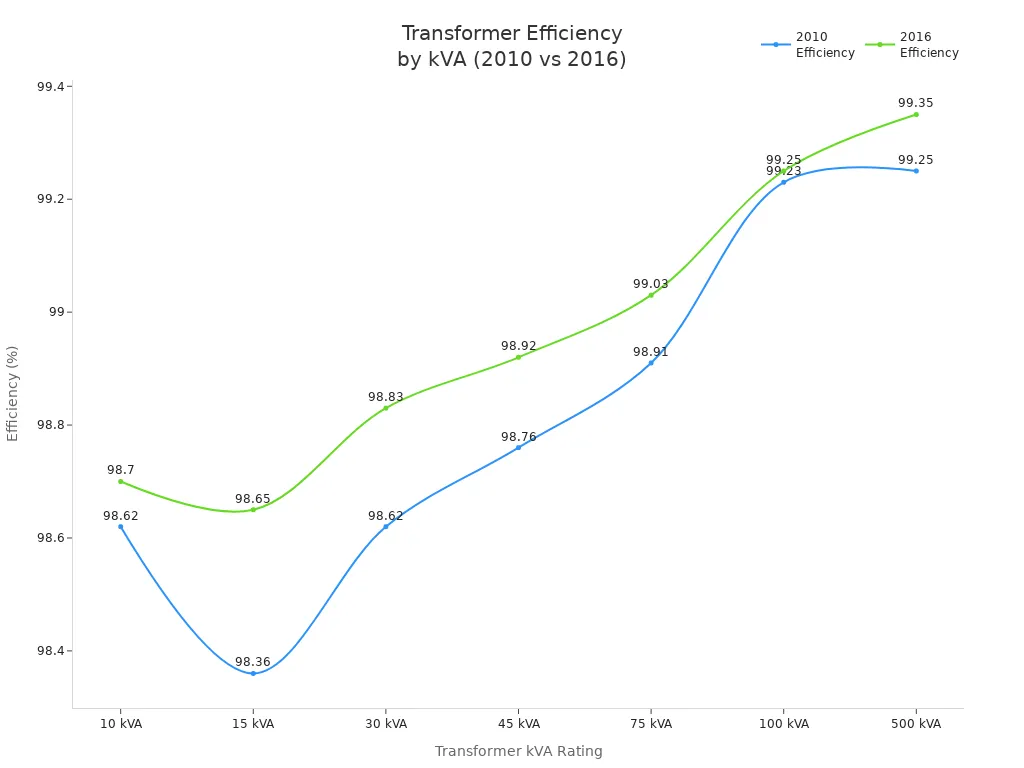
You notice that most transformers now reach efficiency ratings above 98%. This means you lose very little energy during voltage conversion.
You can think of a transformer like a relay race. Imagine you have two runners. The first runner (primary winding) carries a baton (electricity) and runs a certain distance (primary current). When the first runner reaches the handoff point (the core), the baton gets passed to the second runner (secondary winding). The second runner then continues the race (secondary current) at a different speed (voltage level), depending on the rules (number of turns in the winding).
Just like in a relay race, the baton never leaves the track, but it changes hands. In a transformer, electricity never jumps directly from one winding to the other. The magnetic field acts as the handoff point, allowing energy to move safely and efficiently.
You use a transformer every time you plug in your phone charger or turn on a light. The transformer inside these devices makes sure you get the right voltage and current. Whether you need a step-down transformer for your laptop or a step-up transformer for power transmission, you rely on this simple but powerful device every day.
You encounter several main types of transformer in daily life and industry. Each type serves a specific purpose and comes with unique features. Here is a table that highlights the most common transformer types, their descriptions, and key specifications:
| Type of Transformer | Description | Specifications |
|---|---|---|
| Liquid-Filled Transformers | Use dielectric fluid for cooling and insulation. | Insulation class around 120°C; ideal for outdoor use; excellent heat dissipation. |
| Dry-Type Transformers | Designed for indoor environments, cooled by air. | Insulation class up to 220°C; higher winding temperature rise; less effective during overloads. |
| Power Transformers | Transfer energy to substations for power transmission. | Large size; ratings from 30KVA to over 7000KVA; usually three-phase. |
| Distribution Transformers | Step down grid voltage for homes and businesses. | Single-phase or three-phase; size varies by capacity. |
| Measurement Transformers | Isolate main power and convert current or voltage for measurement. | Used for monitoring phase, current, and voltage; often called instrument transformers. |
You also see padmount, substation, and pole mount transformers in public spaces, industrial sites, and on utility poles.
A transformer plays a vital role in every electrical system. You depend on it for safe, efficient, and reliable electricity. The right transformer ensures voltage matches your needs and protects your devices. Here are some key reasons why transformers matter:
They regulate voltage to prevent damage to equipment.
They reduce energy loss during power transmission.
They improve the performance and lifespan of electrical devices.
They support the integration of renewable energy sources.
Proper transformer selection depends on voltage, current, capacity, efficiency, environment, and cost. Choosing the right transformer helps you save energy and money.
| Benefit | Description |
|---|---|
| Voltage Regulation | Adjusts voltage to optimal levels for your equipment. |
| Reduced Energy Loss | Minimizes heat and saves energy during operation. |
| Improved Equipment Performance | Keeps your devices running smoothly and extends their life. |
You find transformers everywhere, from your home to large factories. Here are some of the most common applications:
Residential and Commercial Power: Distribution transformers step down voltage for safe use in homes and offices.
Industrial Facilities: Power transformers handle high loads and supply energy for heavy machinery.
Automobile Industry: Custom transformers charge electric vehicle batteries and monitor voltage.
Steel Manufacturing: Specialized transformers deliver high currents for steel production.
Electrochemical Industry: Rectifier transformers support electroplating and other chemical processes.
Public Infrastructure: Padmount and pole mount transformers provide power in public areas and neighborhoods.
You rely on transformers for everything from charging your phone to running entire cities. Without them, modern power transmission and daily life would not be possible.
You rely on power electrical transformers to adjust voltage, transfer energy, and keep your devices safe.
| Main Point | Description |
|---|---|
| Functionality | Transformers step up or down voltage for efficient, safe power delivery. |
| Reliability | Advanced features protect against overloads and ensure stable operation. |
You use transformers in homes for electronics, lighting, and security systems every day.
You risk damaging your devices or causing electrical hazards. Always match the transformer’s voltage and current ratings to your equipment.
No, you cannot. Transformers only work with alternating current (AC). You need a different device, like an inverter, for DC to AC conversion.
Look for signs like overheating, strange noises, or a burning smell. If you notice these, turn off the transformer and contact a professional.

Electrical Transformer Procurement Checklist: Sizing, Standards, Testing and Delivery
Electrical transformer procurement involves more than requesting several prices for the same kVA rating. A technically incomplete inquiry can produce offers that look comparable but include different insulation levels, losses, etc.
Jul. 30, 2026

How to Choose the Right Electrical Transformer for Your Project
Selecting an electrical transformer is not simply a matter of matching an incoming voltage to an outgoing voltage. The transformer must also support the real load profile, withstand expected fault conditions, operate within the site environment.
Jul. 30, 2026